



Articles
Why do we implant chips at certain locations for certain animals?
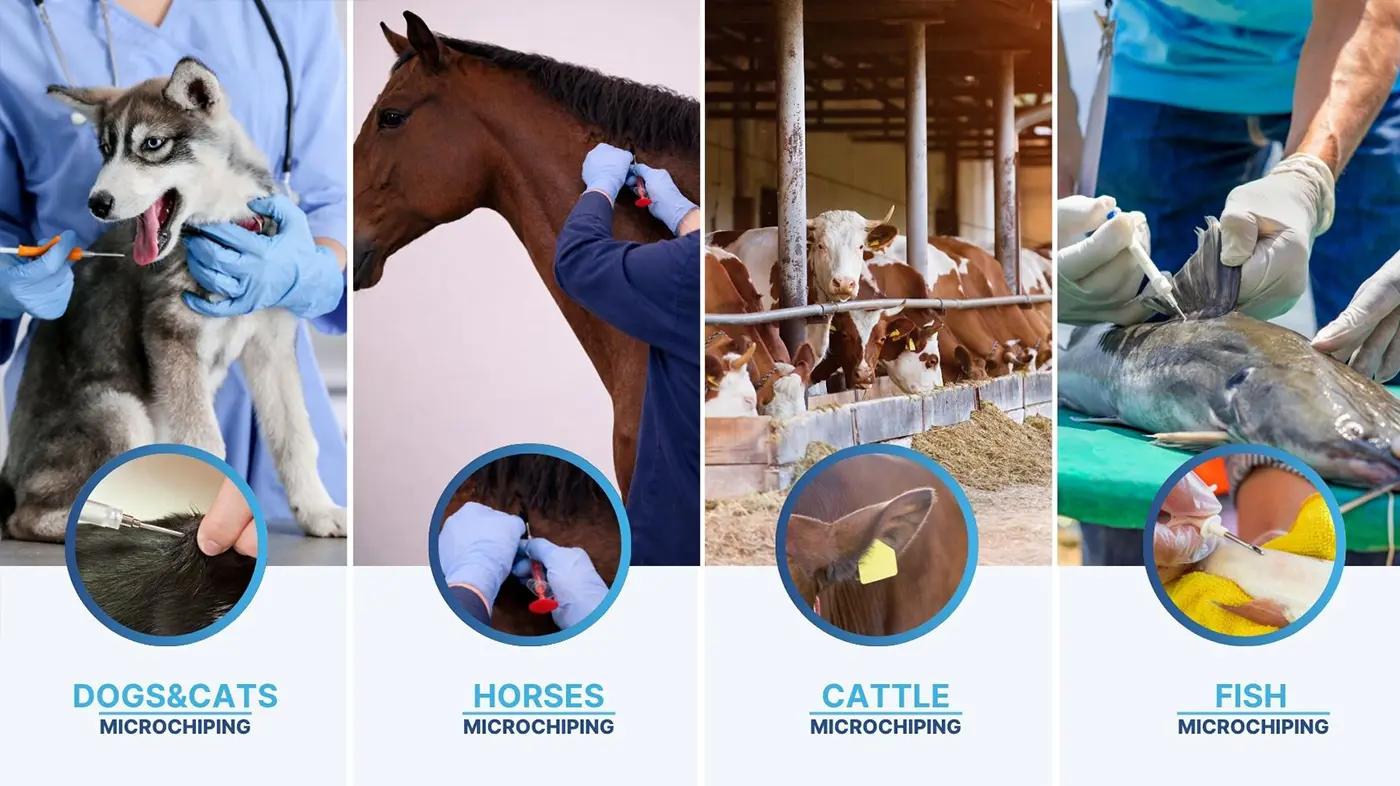
Same Chip, Different Animal: Why Microchip Placement Matters More Than You Think ?
Why Does Placement Matter?
Imagine a pet already microchipped, but when scanned, the chip cannot be detected.
In many cases, this happens because the microchip was implanted in the wrong location or migrated from its original position.
That’s why defining a clear and appropriate implantation site is just as important as the microchip itself.
Proper placement helps minimize migration and ensures accurate identification throughout the animal’s lifetime.
Since each species has unique anatomical structures, placement matters.
Dogs and Cats
Microchips are implanted subcutaneously between the shoulder blades.
This area has loose skin, is away from vital organs.
Horses
Microchips are typically implanted in the nuchal ligament on the left side of the neck.
This position reduces chip movement.
Cattle
Identification is commonly achieved using external ear tags embedded with microchips.
This allows for easy detection, efficient management of large herds, and improved farm traceability.
Fish
For smaller fish (under 30 cm), microchips are implanted in the body cavity.
For larger fish, implantation is done in the dorsal musculature to avoid vital organs and ensure chip stability in aquatic environments.
A microchip works best when placed in the right location, because precision starts from the moment it is implanted.