



Articles
5 Industries Where LF RFID Still Holds Its Ground
Why LF RFID Still Matters
Newer wireless technologies get most of the headlines, but Low Frequency RFID technology quietly keeps the world running in places where reliability matters more than speed. Water, dirt, and underground conditions that challenge many wireless systems are reliable performance. It’s one of the few technologies trusted enough to be implanted into a living animal and forgotten about for years.
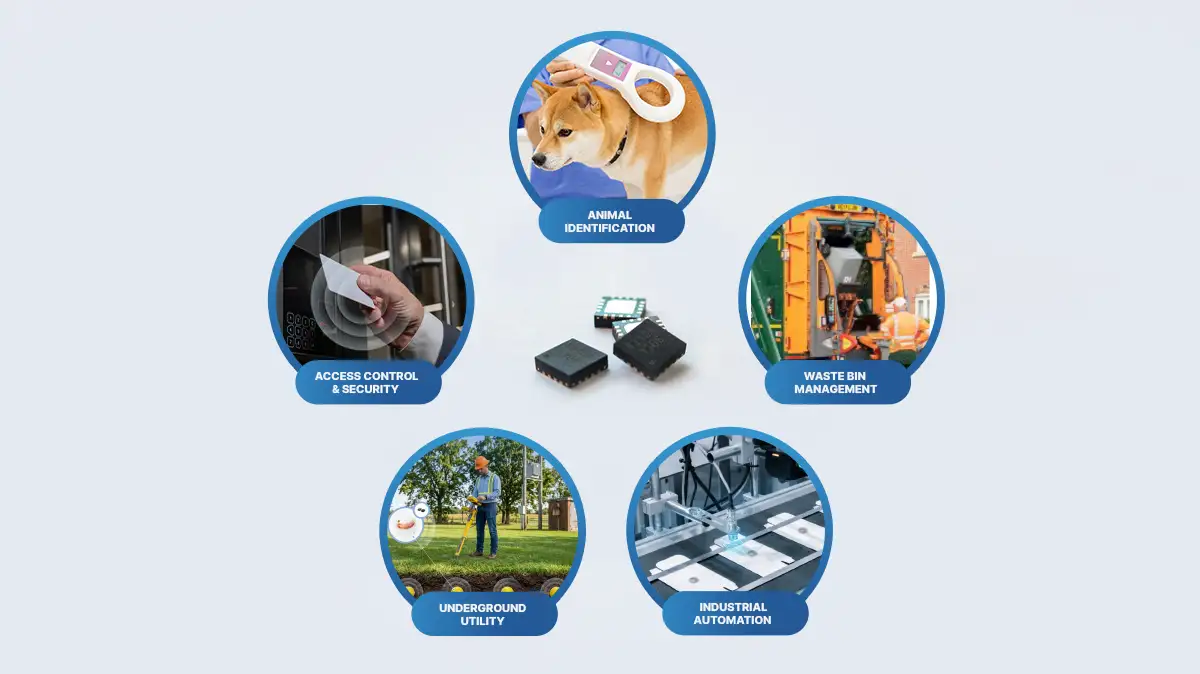
1. Animal Identification and Livestock Management
From pet microchips to cattle tracking, LF RFID microchip provides lifetime identification that works reliably under skin and fur. It requires no battery and provides reliable performance. Moreover, it’s one of the few technologies trusted enough to be implanted into a living animal. It can then be forgotten about for years.
2. Access Control and Security Systems
Employee badges and building access cards still widely run on LF RFID technology because it’s simple operation and stable performance. Also, it’s difficult to accidentally trigger from a distance. In security applications, predictability isn’t a weakness, it’s the whole point.
3. Industrial and Manufacturing Automation
Compared to alternative technologies, LF RFID holds up better in environments with moisture and dirt. This is why it remains a reliable choice for asset tracking, tool management, and production control on demanding factory floors.
4. Waste Bin Management
Waste bins embedded with LF RFID tags are automatically identified the moment they are collected. As a result, this makes it practical for municipalities and waste operators to manage collection routes, monitor usage patterns, and run pay-as-you-throw billing systems accurately and at scale.
5. Underground Utility and Asset Tracking
Marking underground cables, pipelines, valves, and utility infrastructure is one of those problems that sounds simple until something goes wrong. LF RFID tags can be detected without any direct line of sight, helping maintenance teams pinpoint buried assets quickly, cut down excavation time, and avoid accidental damage during construction or repair work.