



Articles
Why RFID Temperature Sensors Prove Medicine Stayed Cold
The Hidden Challenge of Pharmaceutical Cold Chains
Every year, the pharmaceutical industry loses an estimated $35 billion to a single quiet problem: products that got too warm, or too cold, somewhere between the factory and the patient.
Many modern medicines, vaccines, insulin, biologics, only work if they stay inside a narrow temperature window, often just 2 to 8°C. Step outside it, even briefly, and a product can look perfectly fine while quietly losing its strength. The World Health Organization estimates that up to half of all vaccines are wasted globally each year, and broken cold chains are a major reason why.
Why Traditional Temperature Data Loggers Have Limitations
So how do we know a shipment actually stayed safe? Today, most companies clip a battery-powered data logger onto a pallet. It works, but it has limits. Loggers are expensive, their batteries run down, they need regular calibration, and one logger usually speaks for an entire pallet. If it raises an alarm, every carton on that pallet becomes suspect, even if only a few were ever at risk.
How Passive RFID Temperature Sensors Work
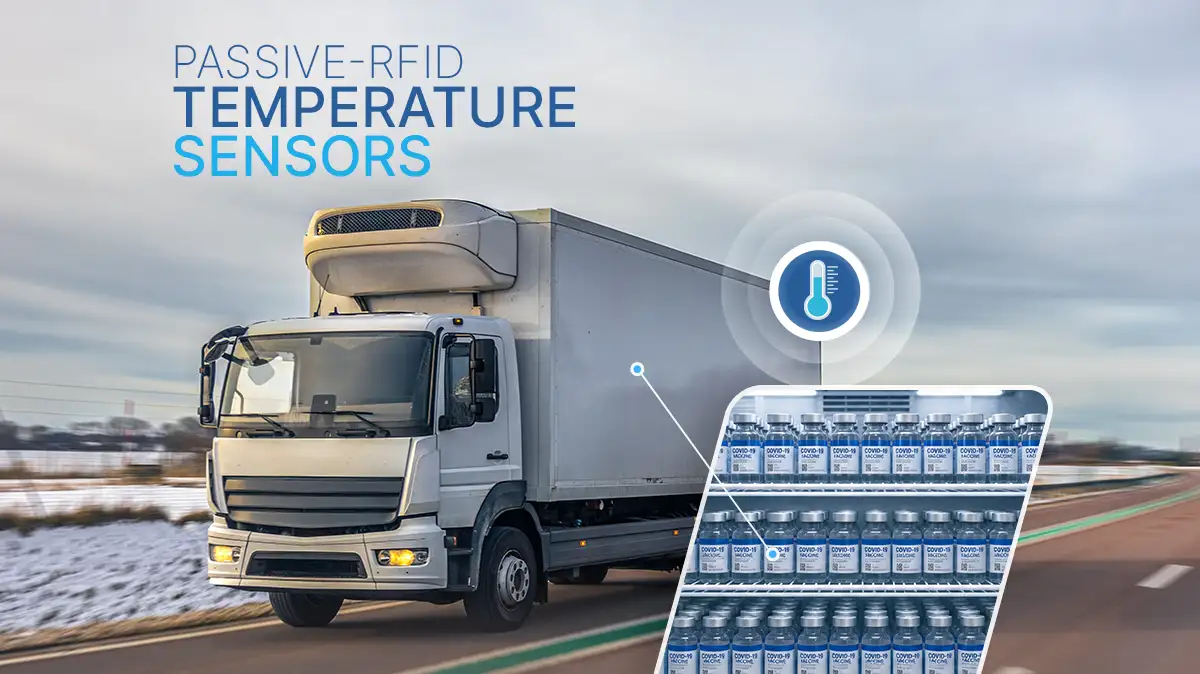
There is a quieter option already taking shape: passive RFID temperature sensors. These are thin, battery-free labels. They hold no power of their own. When a standard RFID reader sends out its signal, the same kind warehouses already use to scan inventory, the label borrows that energy, takes a temperature reading, and sends the answer back. Nothing to charge. No expiry date. A label applied today still works years from now.
Benefits of RFID Temperature Sensors for Pharmaceutical Logistics
Because each label costs only cents, you can put one on every box, even every vial, instead of one logger per pallet. And because the readers already exist in the warehouse, this is not a new system to install; it is an upgrade at the label level.
Meanwhile, regulators in the EU, the US and the WHO keep tightening the rules on proving temperature history, and the industry is moving steadily toward finer-grained visibility, down toward the level of the individual item.
For decades, an RFID tag has told us what a product is. The next step is letting it also tell us how it was treated along the way.