



Articles
Smart Packaging Detects Spoilage With NFC Gas Sensing
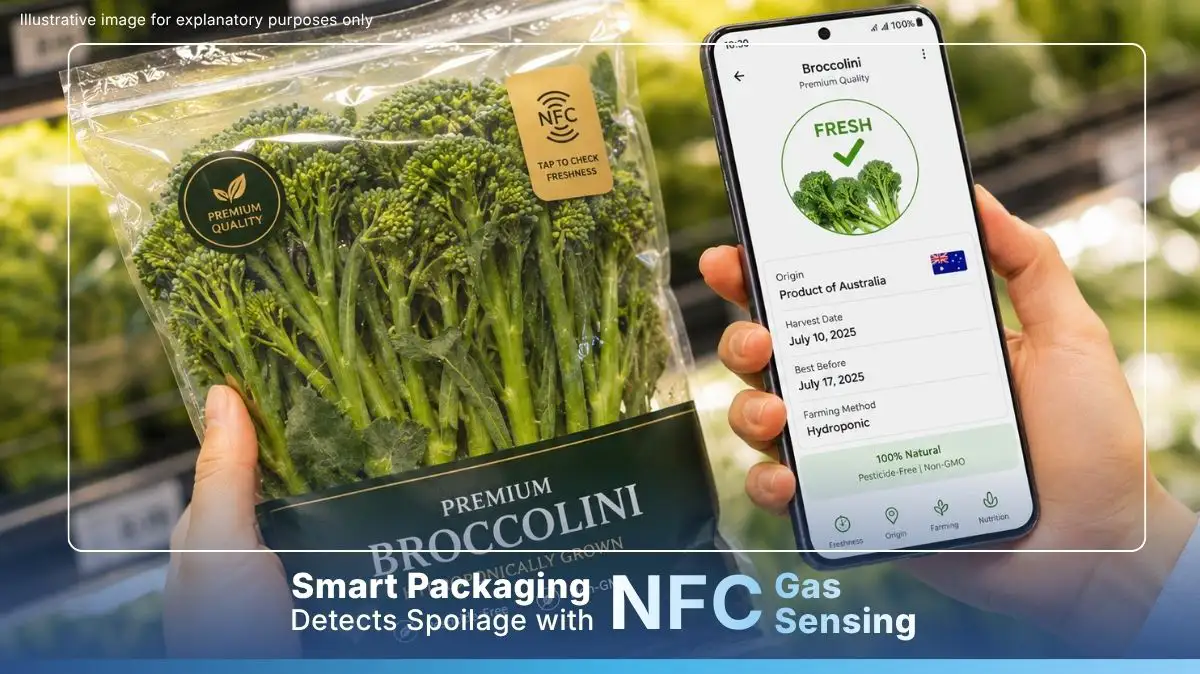
Food waste is one of the biggest inefficiencies in the global supply chain. Fresh produce loses a significant share between processing, distribution, and the home, and leafy greens are especially vulnerable. Spinach is a high-value crop. It often spoils well before its printed expiry date, so it gets thrown out too soon. Because of this, a research team at Imperial College London set out to solve the problem. The team, led by Firat Güder and Laura Gonzalez-Macia, made packaging that reports on freshness itself. As a result, quality monitoring moves from the label to the contents inside.

Fig. 1: A shopper examining product labels on packaged vegetables at a retail grocery store.
How Gas Sensing Detects Spoilage
The approach centers on gas sensing using paper-based electrical sensors that respond to the gases released as food deteriorates. As produce spoils, it gives off water-soluble gases such as ammonia. These gases dissolve into a thin moisture layer on the cellulose sensor and change its electrical conductance. This produces a measurable signal that tracks spoilage over time. Because the method reads gases in the package headspace, it needs no sample preparation. It can also monitor freshness continuously, rather than at a single checkpoint.
An NFC Tag Without a Battery
To make the sensor wireless and disposable, the team integrated it with a near-field communication tag. The system uses a planar, single-coil copper antenna operating at 13.56 MHz. This antenna pairs with the Silicon Craft’s SIC4341 Tag Chip, which provides a potentiostat sensor interface. This lets the chip read conductance and talk to a smartphone at the same time, with no battery needed. During the tap, the phone supplies all the energy needed. Through a custom mobile app, each measurement takes roughly 20 seconds. Once the sensor equilibrates inside the package, the app shows the user a simple “Fresh” or “Not Fresh” result.
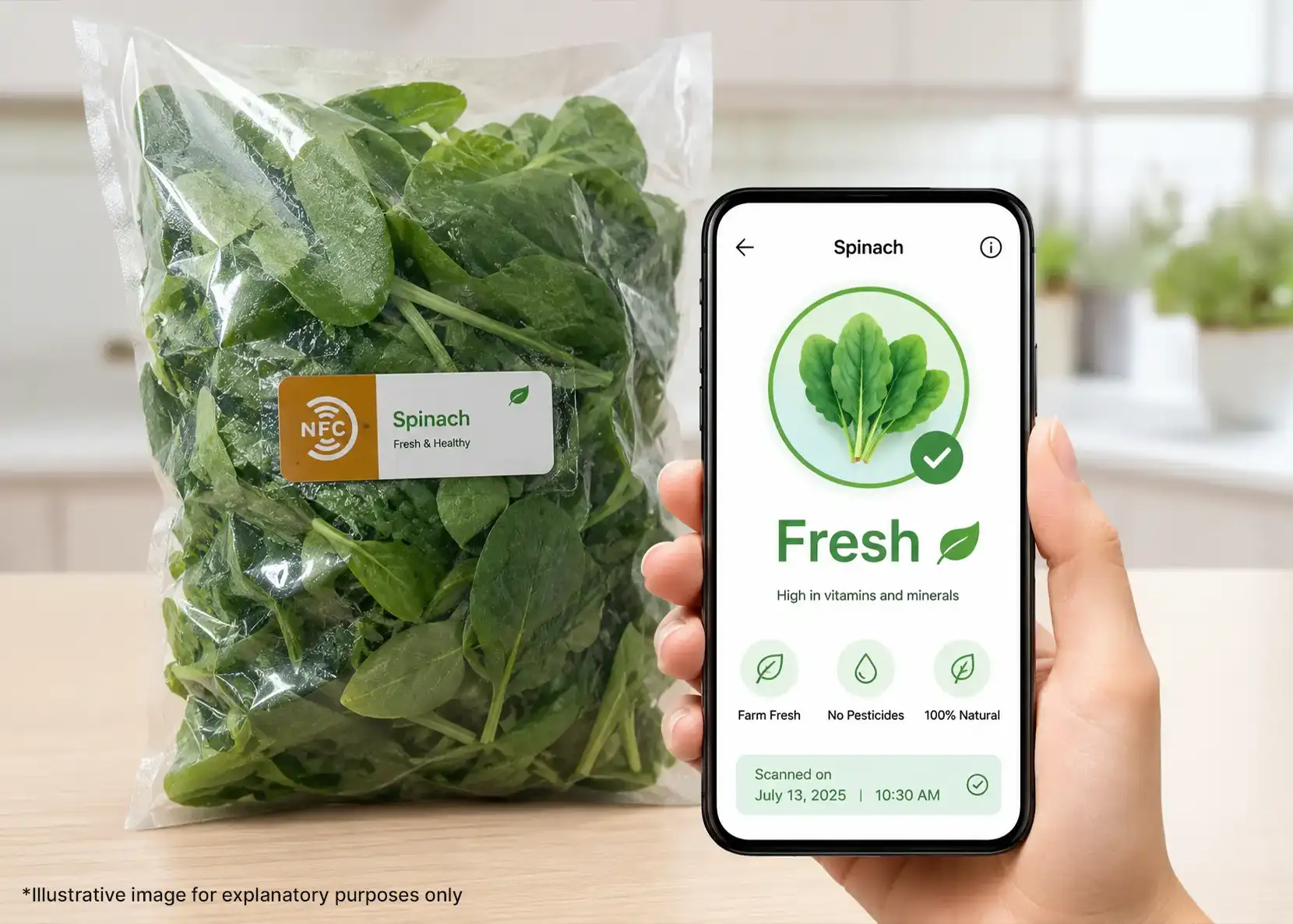
Fig. 2: NFC gas sensing on packaged spinach, delivering a battery-free, real-time freshness reading via smartphone.
Buit to Be Affordable and Disposable
A key strength of the design is its economics. Low-cost, commercially available materials keep the full gas sensing label to around US $0.35 per unit. As a result, it’s practical for single-use deployment on individual packs. In tests on bagged spinach, the system reliably told fresh samples from spoiled ones. The results matched laboratory microbial counts.
As a proof of concept focused on spinach, the work points toward a broader future for intelligent packaging. The same encapsulation and gas sensing scheme can adapt to other perishables. In addition, networked NFC tags could one day support freshness checks across the distribution chain. For consumers, retailers, and suppliers, that means clearer information at the point of decision. It also means better inventory management and less avoidable food waste.
Learn more about our NFC Sensor microchip products at Silicon Craft Product: NFC for Sensor
Reference
Naik, A., Lee, H. S., Herrington, J., Giandrin Barandun, Flock, G., Firat Güder, & Gonzalez-Macia, L. (2024). Smart Packaging with Disposable NFC-enabled Wireless Gas Sensors for Monitoring Food Spoilage. ACS Sensors. https://doi.org/10.1021/acssensors.4c02510